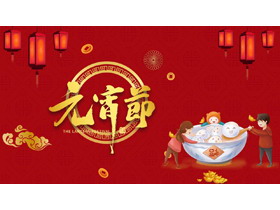


這是一套紅色卡通湯圓背景元宵節英文介紹PPT模板,共27頁;
PPT模板使用了一張中小學元宵節主題英語課的 PPT 封面背景圖,整體風格活潑童趣。
畫面以暖米色為底色,中央的紅色橢圓框內,醒目的白色英文大字 “HAPPY LANTERN FESTIVAL” 點明主題,下方標注 “中小學元宵節主題英語課”;右側是一碗盛著卡通湯圓的碗,湯圓都帶著俏皮的表情,左側點綴煙花、銅錢元素,四角用書法字體寫著 “元、宵、喜、樂”,整體既貼合元宵主題,又很適合課堂使用。
PowerPoint模板內容頁,由25張紅色動態幻燈片圖表,搭配PPT文字排版。另外使用了卡通元宵插圖、卡通小朋友插圖等裝飾。
元宵節英文介紹PPT內容簡介:
一、The origin of the Lantern Festival 元宵節的由來
課堂導入
Students, do you know what day it is?
同學們,你們知道今天是什么日子嗎?
New Year 15(正月十五),即 Lantern Festival(元宵節)。
名稱釋義(中英對照)
The first lunar month is the first month of the lunar calendar, and the ancients called "night" "xiao". The 15th day of the first lunar month is the first full moon night of the year, so it is called the "Lantern Festival".
正月是農歷的元月,古人稱 “夜” 為 “宵”,正月十五是一年中第一個月圓之夜,所以稱正月十五為 “元宵節”。
According to the Taoist "Sanyuan", the fifteenth day of the first month is also known as the "Shangyuan Festival".
根據道教 “三元” 的說法,正月十五又稱為 “上元節”。
Since ancient times, the Lantern Festival customs have been dominated by the warm and festive lantern viewing custom.
元宵節習俗自古以來就以熱烈喜慶的觀燈習俗為主。
節日發展歷程(中英對照)
The formation of the Lantern Festival has a long process, rooted in the ancient custom of folk lighting to pray for blessings.
元宵節的形成有一個較長的過程,根源于民間開燈祈福古俗。
Western han dynasty(西漢):The 15th day of the first month has already been taken seriously. 正月十五在西漢已經受到重視。
After Han Wei(漢魏之后):The Lantern Festival on the 15th day of the first month is truly a national folk festival. 正月十五元宵節真正成為全國民俗節日。
Tang dynasty(唐朝):Burning lanterns to offer to the Buddha, Buddhist lanterns spread throughout the people, and lanterns became a legal thing. 民眾燃燈供佛,燈火流傳民間,元宵張燈成為法定之事。
Song dynasty(宋代):Also known as the Night of Lights. 元宵節也稱燈夕。
Qing dynasty(清代):Also known as the Festival of Lights. 元宵節另稱燈節。
二、The legend of the Lantern Festival 元宵節的傳說
(一)Commemoration of “Pinglü” 紀念 “平呂”(中英對照)
起源背景
Legend has it that the Lantern Festival was established during the reign of Emperor Wen of Han to commemorate "Pinglü".
傳說元宵節是漢文帝時為紀念 “平呂” 而設。
After the death of Liu Bang, the ancestor of the Han Dynasty, Liu Ying, the son of Empress Lü, ascended the throne as Emperor Hui of Han.
漢高祖劉邦死后,呂后之子劉盈登基為漢惠帝。
諸呂之亂經過
After Emperor Hui of Han died of illness, Empress Lü monopolized the imperial government and turned Liu's world into Lü's world. The old ministers and Liu clan were deeply indignant, but they were afraid of Empress Lü's brutality and dared not speak out.
漢惠帝病死后,呂后獨攬朝政,將劉氏天下變為呂氏天下,朝中老臣與劉氏宗室憤慨不已,卻因畏懼呂后而敢怒不敢言。
After Empress Lü died of illness, Zhu Lü was terrified and secretly gathered to stage a rebellion to seize power.
呂后病逝后,呂氏一族惶恐不安,暗中聚集密謀作亂,企圖奪取劉氏江山。
This matter was known by Liu Xiang, the king of Qi. He decided to raise troops to fight against Zhu Lü, and united with ministers Zhou Bo and Chen Ping to put down the "Rebellion of Zhu Lu" completely.
此事被齊王劉襄得知,他決定起兵討伐諸呂,聯合周勃、陳平一眾老臣,徹底平定了諸呂之亂。
節日確立
After the rebellion, the courtiers supported Liu Heng, the fourth son of Liu Bang, on the throne, and became Emperor Wen of Han.
平亂之后,眾臣擁立劉邦第四子劉恒登基,即漢文帝。
Emperor Wen felt that peace and prosperity were not easy to come by, so he designated the fifteenth day of the first month to quell the "Rebellion of Zhulu" as a day of fun with the people, and every family in the capital put up lanterns to celebrate.
漢文帝感念太平盛世來之不易,將平定諸呂之亂的正月十五定為與民同樂日,京城家家戶戶張燈結彩以示慶賀。
Since then, the 15th day of the first lunar month has become a folk festival celebrated everywhere - "Lantern Festival".
從此,正月十五便成了普天同慶的民間節日 ——“鬧元宵”。
相關補充
During the reign of Emperor Wudi of Han, the sacrifice of the "Taiyi God" was set on the fifteenth day of the first month. (Taiyi: God who rules over everything in the universe).
漢武帝時,將祭祀 “太一神”(主宰宇宙萬物之神)的活動定在正月十五。
It is said that when Sima Qian created the "Taichu Calendar", he had already identified the Lantern Festival as a major festival.
據說司馬遷編撰《太初歷》時,就已將元宵節定為重大節日。
(二)The origin of the lighting lights 點彩燈的來歷(中英對照)
起因
Legend has it that a long, long time ago, there were many fierce birds and beasts hurting people and livestock. People organized to drive them away. A sacred bird got lost and landed on earth, but was accidentally shot to death by an unsuspecting hunter.
相傳遠古時期,世間兇禽猛獸橫行,傷害人畜。人們聯手驅趕猛獸,一只神鳥迷路降落人間,卻被獵人誤殺。
天帝降怒與報信
When the Heavenly Emperor found out, he was very angry and ordered the Heavenly Soldiers to set fire to the world on the fifteenth day of the first month, burning all people and property.
天帝得知后勃然大怒,下令天兵于正月十五下凡縱火,燒毀人間人畜與財物。
The daughter of the Heavenly Emperor was kind-hearted. She risked her life to come to the world secretly and told people the bad news. Everyone was extremely frightened.
天帝之女心地善良,她冒著危險悄悄來到人間,告知眾人噩耗,百姓聽聞后驚慌失措。
化解危機
An old man came up with a solution: "On the 14th, 15th, and 16th days of the first lunar month, every family puts up lights, lights firecrackers, and sets off fireworks. In this way, the Heavenly Emperor would think that people were burned to death."
一位老者獻策:正月十四、十五、十六三日,家家戶戶張燈結彩、燃放爆竹煙火,讓天帝誤以為人間已被大火吞噬。
Everyone followed the advice and made preparations.
眾人依計行事,紛紛著手準備。
習俗流傳
On the night of the fifteenth day of the first month, the Heavenly Emperor looked down and saw red lights and loud noises all over the world for three consecutive nights. He thought the world was on fire and felt very pleased.
正月十五夜晚,天帝望見人間紅光漫天、聲響震天,連續三日皆是如此,以為人間已被大火焚毀,心中十分滿意。
In this way, people saved their lives and property. To commemorate this success, every household hangs lanterns and sets off fireworks on the 15th day of the first lunar month from then on.
百姓得以保全性命與財產。為紀念此事,此后每到正月十五,家家戶戶都會掛燈籠、放煙火,這一習俗便流傳下來。
三、The celebration custom of the Lantern Festival 元宵節的慶祝習俗
課堂互動
Discussion time 討論時間
What do you know about the customs of the Lantern Festival?
你所了解的元宵節的習俗有什么?
總述
The customs of the Lantern Festival are varied in different regions. Besides dragon lantern dance and eating tangyuan, there are many interesting customs.
元宵節習俗豐富多樣,各地風俗不一,除了舞龍燈、吃湯圓這些常見習俗外,還有許多趣味傳統。
各類習俗詳解(中英對照)
Rat-by-rat 逐鼠
Began in the Wei and Jin dynasties, mainly popular among silkworm farmers. Because mice often eat silkworms at night, people feed mice with rice porridge on the fifteenth day of the first month, believing that it will stop mice from eating silkworms.
該習俗始于魏晉時期,主要流行于養蠶人家。因老鼠常在夜間啃食蠶蟲,人們便在正月十五用米粥喂老鼠,以此祈求老鼠不再傷害蠶。
Send lights 送燈
Also known as "sending flower lanterns". During the Lantern Festival, the bride's family sends lanterns to newly married daughters, or relatives and friends send lanterns to newly married couples without children. Since "lamp" and "ding" (offspring) are homophones, it is a good wish for newlyweds to have babies soon and live a happy life.
也稱 “送花燈”。元宵期間,娘家會給出嫁的女兒送花燈,親友也會給新婚未育的家庭送燈。因 “燈” 與 “丁” 諧音,寄托了期盼添丁、生活順遂的美好祝愿。
Door Festival 門祭
It is one of the ancient "seven sacrifices". People insert poplar branches above the door, put a pair of chopsticks in a bowl of bean porridge, or place wine and meat in front of the door for sacrifice.
門祭是古代 “七祭” 之一。人們將楊樹枝插在門戶上方,在盛有豆粥的碗里插上筷子,或是直接在門前擺放酒肉進行祭祀。
Dry boating 劃旱船
Also known as running dry boats. People imitate the movement of boating on land. The performer ties a boat-shaped prop made of bamboo and wood around the waist, holds an oar, imitates rowing movements, sings local folk tunes while performing.
也稱跑旱船。表演者在陸地上模仿行船動作,將竹木制作的船形道具系在腰間,手持船槳模擬劃行,一邊跑動一邊演唱地方小調,載歌載舞。
... ... ...
本模板適合用于制作元宵節節日介紹PPT、元宵節習俗介紹PowerPoint。.PPTX格式;